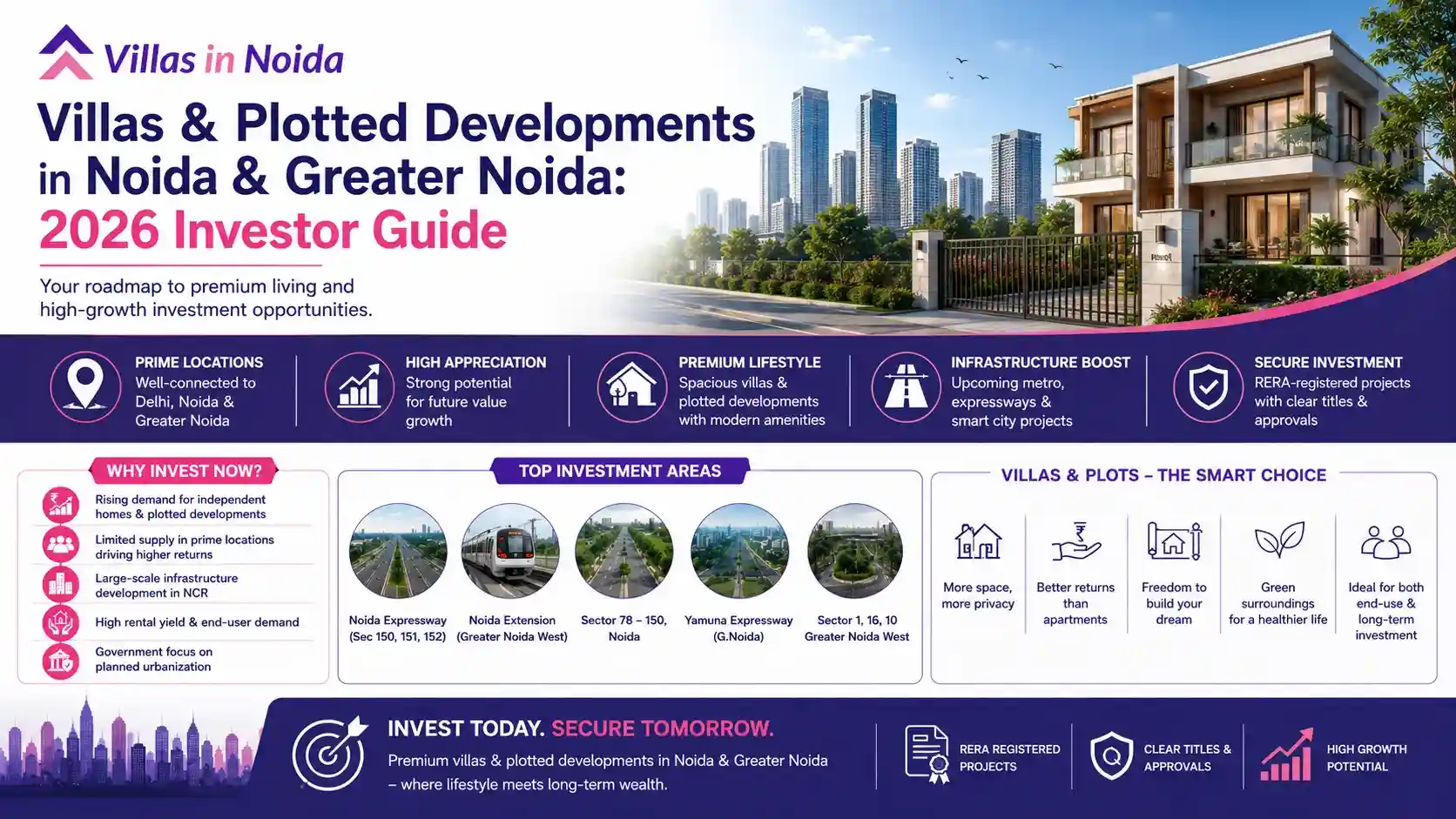
This guide walks through what's actually driving the market in 2026, what villas and plots cost across the region's key micro-markets, and what an investor should check before signing anything.
Why 2026 Is a Turning Point
The Noida International Airport received its provisional aerodrome licence from the Directorate General of Civil Aviation in early March 2026, was inaugurated by the Prime Minister on March 28, and began commercial flights on June 15, 2026, with IndiGo, Air India Express, and Akasa among the first carriers to operate out of it. Phase one alone is built to handle 12 million passengers a year across a 4,000-metre runway and a 90,000 sq. m terminal — with long-term capacity plans stretching to over 70 million passengers annually.
That single piece of infrastructure has reshaped demand along the entire Yamuna Expressway corridor. The government has also designated the Jewar region part of an Integrated Industrial Township, and electronics, semiconductor, and logistics companies are setting up operations nearby — which means a steady incoming workforce that needs housing, not just speculative land-banking.
Villas vs. Plotted Developments — What's the Difference
Villas are ready-built (or under-construction) independent or semi-independent houses inside a gated community, typically with a private garden, terrace, and shared amenities like a clubhouse, pool, and sports facilities. You buy a finished (or nearly finished) home.
Plotted developments sell you the land itself, usually inside an authority-approved or private layout with roads, sewage, and electricity infrastructure already planned. You then build to your own design and timeline, or hold the plot as a longer-term land-value play. Plots generally carry lower entry costs than villas and tend to appreciate closer to raw land-value trends, but they also mean more upfront legwork — construction approvals, builder-free execution — unless you're buying purely to resell later.
Both categories exist across every micro-market below, though the mix shifts by location.
Key Growth Drivers to Watch
- Airport ramp-up. Passenger volume, cargo operations, and airline route additions over the next 12–24 months will be the clearest real-time signal of whether the corridor's growth is durable.
- Semiconductor and electronics manufacturing. New industrial investment near Jewar is expected to create employment that supports genuine end-user housing demand, not just investor flipping.
- Metro and expressway connectivity. Planned metro extensions toward the airport and new expressway links across Sectors 20–35 are frequently cited as near-term catalysts for adjoining sectors.
- Maturing infrastructure. Greater Noida in particular has shifted from low-rise colonies and plotted layouts toward high-rise development over the past decade — a sign of a market moving from early-stage to more established.
Risks Worth Taking Seriously
No corridor this hot is risk-free, and a few cautionary points are worth keeping in mind:
- Airport timelines have slipped before. The Jewar Airport's inauguration date was rescheduled multiple times before finally landing in March 2026. Infrastructure-linked appreciation stories can take longer to play out than marketing material suggests.
- This is not a short-term flip. Analysts covering the region generally caution against expecting meaningful returns within 12–18 months; the thesis here is a multi-year, infrastructure-led one.
- Verify RERA registration. Most projects across Greater Noida and Noida Extension are registered, but this should never be assumed — check the UP RERA portal directly for any specific project.
- Check builder credibility and possession timelines independently, especially for under-construction villas and private plotted layouts, where delivery delays are the most common source of investor frustration.
- Land near an under-construction industrial corridor can be volatile. Prices in fast-moving corridors like Jewar can run ahead of actual infrastructure delivery, so price momentum alone shouldn't be the only basis for a decision.
Who This Market Suits
Villas and plots in this corridor tend to suit two different kinds of buyers reasonably well: end-users looking for a lower-density, amenity-rich home within striking distance of Delhi NCR's job centers, and longer-horizon investors comfortable holding through a multi-year infrastructure build-out rather than chasing a quick resale. It's a less natural fit for anyone expecting fast liquidity or guaranteed short-term appreciation — real estate cycles, especially ones tied to a single large infrastructure project, don't move in a straight line.
Practical Due-Diligence Checklist
| Step | Action Item |
|---|---|
| 1 | Confirm RERA registration and the project's actual (not marketed) possession date. |
| 2 | Visit the site in person — plotted layouts especially can look very different from renders until roads and utilities are actually laid. |
| 3 | Compare price-per-sq.-ft. across at least three comparable projects in the same sector before committing. |
| 4 | Ask directly about resale liquidity in that specific project or layout — some gated villa communities have thin resale markets. |
| 5 | For plots, confirm land-use approvals and whether construction is time-bound by the allotting authority. |
| 6 | Get an independent legal check on title, especially for older private layouts versus fresh authority allotments. |
"Genuinely improving fundamentals" and "guaranteed quick returns" are two different things, and the sharpest investors in this market right now are the ones treating it as a multi-year thesis.
The Bottom Line
The Jewar Airport has genuinely changed the investment conversation around Noida, Greater Noida, and the Yamuna Expressway — it's a real, operating piece of infrastructure now, not a promise. That's meaningfully different from the speculative buildup of years past. But "genuinely improving fundamentals" and "guaranteed quick returns" are two different things, and the sharpest investors in this market right now are the ones treating it as a multi-year thesis, doing their own verification on RERA status and builder track record, and choosing locations based on realistic connectivity and construction timelines rather than headline growth percentages alone.
This guide is for general informational purposes and isn't financial or legal advice. Property investment decisions should be made after independent verification of project approvals, title, and RERA status, and ideally with input from a qualified financial or legal advisor.